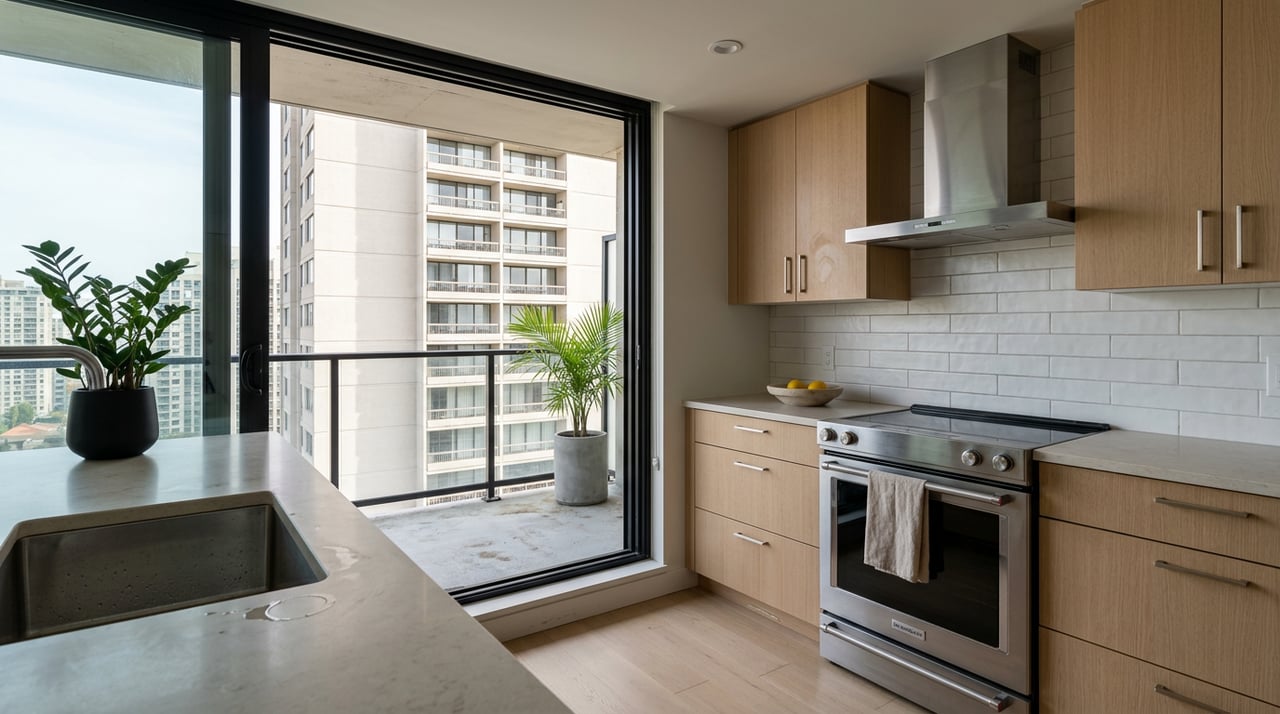
A two-bedroom corner unit came on the market this year at Ocean Club, one of the boutique oceanfront buildings on Galt Ocean Mile. The listing reads the way these listings usually read: floor-to-ceiling windows, a wraparound balcony, ocean and Intracoastal views from nearly every room. Then, almost as an afterthought, it notes that the building's recently paid assessment covered concrete restoration, roof work, Structural Integrity Reserve Study compliance, a new pool, and an upgraded pool deck.
That one sentence is worth more to a buyer than the square footage above it.
On a strip of coastline where roughly two dozen high-rises went up in a tight construction window, the number that actually separates one Galt Mile condo from another this year isn't the price per square foot. It's whether the building's structural reserve bill has already been paid or is still coming due. Two units with identical layouts and nearly identical list prices can carry very different real costs of ownership, and the portal listing rarely tells you which one you're looking at until you dig into the association's paperwork.
A Mile Built in a Fifteen-Year Window
Galt Ocean Mile's oceanfront towers were built close together in time, which now means they're aging together too. Galt Towers went up in 1967, a 15-story building with 305 units. Regency Tower followed in 1969, a 20-story tower with 203 residences, and its twin, Regency South, opened in 1970. Most of the mile's high-rises date from the late 1950s through the early 2000s, and the Galt Mile Community Association's own roster lists more than two dozen member buildings sharing that footprint.
A cluster of buildings built within a few years of each other means a cluster of buildings hitting Florida's structural inspection and reserve-funding deadlines at roughly the same time. That's not a coincidence buyers can price around. It's the defining fact of this market right now.
The Law That Ended the Free Ride
Florida's Senate Bill 4-D, passed after the Champlain Towers South collapse in Surfside on June 24, 2021, created two obligations for any condominium three stories or taller: a milestone structural inspection at 25 years for coastal buildings or 30 years inland, and a Structural Integrity Reserve Study covering the roof, load-bearing walls, waterproofing, exterior painting, foundation, plumbing, electrical systems, and windows and doors.
The part that changed the math for owners came later. For budgets adopted on or after December 31, 2024, associations can no longer vote to waive or underfund the reserves that study identifies. For decades, plenty of Galt Mile boards did exactly that, keeping monthly dues low by deferring structural savings year after year. That option is gone. Buildings that spent years underfunding reserves are now required to catch up all at once, and a special assessment is usually how that catch-up gets paid.
Florida Statute 718.504 requires sellers to hand buyers the milestone inspection report, the SIRS, and disclosure of any pending or anticipated special assessment before closing. The Florida Realtors and Florida Bar Condo Rider, updated in December 2024, reinforces the same requirement. If an association can't produce these documents, that gap is itself information worth acting on.
| What to request | What it tells you |
|---|---|
| Milestone inspection report | Whether the building has documented structural deterioration and, if so, how severe |
| Structural Integrity Reserve Study | How much the building needs saved for major repairs, and what percentage is actually funded today |
| Special assessment disclosure | Whether an assessment is already levied, pending a vote, or being discussed by the board |
Ask for all three before you write an offer, not after your inspection period opens. Associations are required to keep these records on file, and a seller who can't produce them within a few days is telling you something.
What the Six-Month Numbers Are Actually Measuring
In the six months ending May 2026, Galt Ocean Mile's oceanfront condo segment logged 103 closed sales, up 24.1 percent from the same period a year earlier. Median sale price rose 2.5 percent to $620,000, and median price per square foot climbed 6.0 percent to $439. Active inventory stood at 121 listings, roughly 7.2 months of supply.
Read on its own, that looks like a straightforward story of rising demand. Read against building age, it looks more like a market splitting in two. Separate listing trackers covering the wider Galt Mile area report days-on-market figures that don't agree with each other, ranging from under 100 days on some counts to well over 130 on others. Regency Tower resales tracked over the twelve months ending June 2026 averaged 147 days on market. Galt Towers resales over the year ending January 2026 averaged 178 days. That spread between individual buildings, not just between different data sources, is the more useful number. Buildings that have already cleared their inspection and funded their reserves are moving faster and supporting the higher end of that price-per-square-foot figure. Buildings still working through the process, or still deciding how to fund it, are sitting longer, which is a large part of why supply remains elevated even as headline pricing climbs.
The median isn't lying. It's just averaging two different products together.
The Elevator Is the Same Story in a Different System
The reserve-funding pressure on Galt Ocean Mile isn't limited to concrete and roofs. On June 9, 2026, the Broward County Commission voted to require association boards to post a public plan for handling elevator outages, with fines starting at $250 the first day and escalating to $500 per day after that until a plan is posted. The ordinance took effect June 23.
The Galt Mile Community Association pushed back publicly, and its response is worth reading for what it reveals about the mile's building stock. Elevator service contracts for these buildings typically run $30,000 to $60,000 a year for maintenance and repair alone, parts included separately. For elevators installed in the 1960s and 1970s, the association noted that some replacement parts are one-of-a-kind and
"sometimes the part has to be manufactured."
Replacing an elevator outright, the association wrote, takes a minimum of six months and more likely 12 to 18. That's not a hypothetical for a building built in 1967 or 1969. It's a maintenance line item that ages exactly the same way the concrete does, and it's a second place a buyer should be checking the reserve study rather than assuming the building's finances are fine because the lobby was recently renovated.
What $439 a Square Foot Actually Buys You
None of this means older buildings on Galt Ocean Mile are a bad buy. Ocean Club's assessment is already paid, which means a buyer there today is purchasing a building with fresh concrete, a new roof, and documented SIRS compliance baked into the price, not looming behind it. That's a materially different position than buying into a building of the same age where the inspection has happened but the reserve funding hasn't caught up yet, because in that second case the bill exists whether or not it has been formally voted on.
The practical move is to stop comparing units by price per square foot alone and start comparing them by where each building sits in this cycle. A slightly higher price on a building that has already absorbed its assessment can be the more predictable purchase. A lower price on a building that hasn't started the process yet is a number with an asterisk you haven't priced in.
Does a newer building on Galt Ocean Mile mean no assessments? Not necessarily. The SIRS requirement applies to any condominium three stories or taller regardless of age, so even a newer tower needs a reserve study on file. The milestone inspection age trigger simply won't hit a newer building for decades, which does buy time.
How do I actually get a building's inspection and reserve documents before I make an offer? Request them directly from the association or through your agent before you write a contract. Associations are required to maintain milestone inspection reports and SIRS documents as part of their official records and to provide them to prospective buyers.
Is a pending special assessment always disclosed before closing? Florida law requires it. Statute 718.504 obligates sellers to disclose milestone inspection reports, the SIRS, and any pending or anticipated special assessment, and the updated Condo Rider reinforces the same requirement for both developer and resale transactions.
Two decades spent on the operations and property management side of this business taught me that the number on the listing sheet is rarely the number that determines whether a purchase makes sense. On Galt Ocean Mile in 2026, that's true in a very literal way. If you're comparing buildings along this stretch and want someone to pull the SIRS, the milestone inspection status, and the assessment history before you write an offer, that's exactly the kind of groundwork Hasnaa Boutros does with clients. Reach out for a Free Home Valuation and a straight read on what a specific building's numbers actually mean for you.