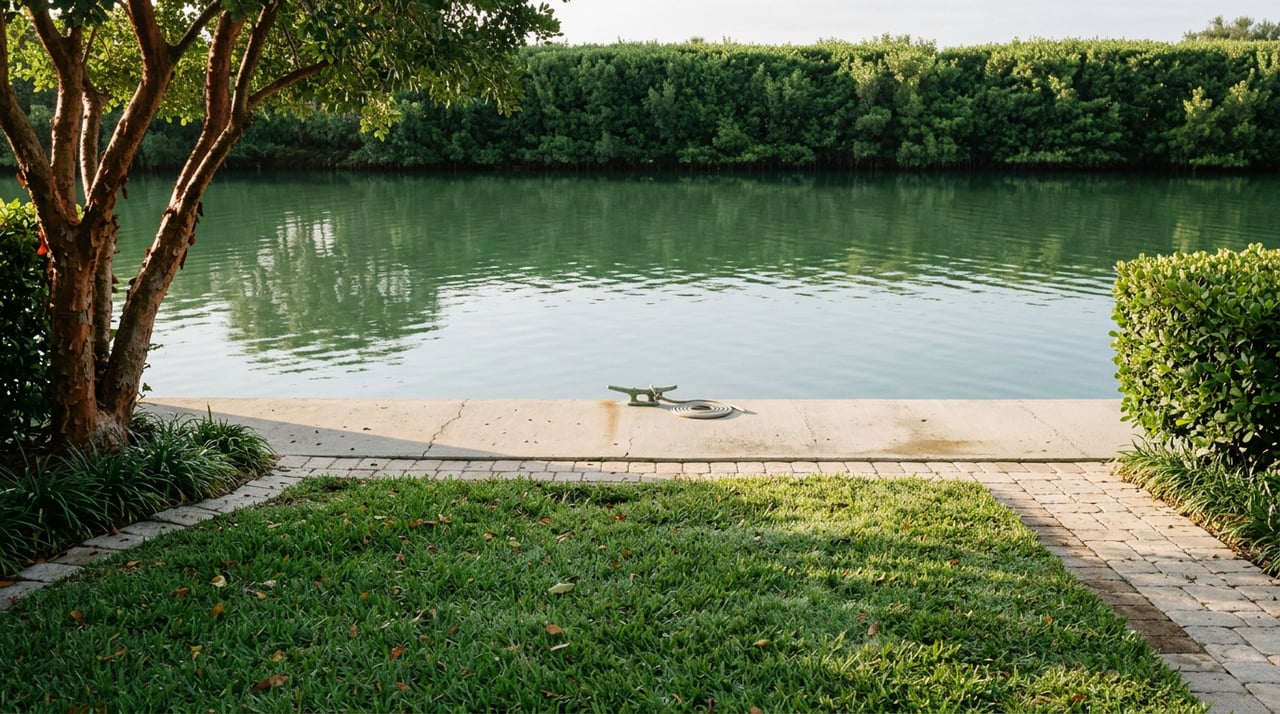
A homeowner on a canal off Lighthouse Drive gets a marine contractor's quote for a cracked seawall panel. The estimate covers one section, maybe 40 feet of a 90-foot wall. The contractor says it's a straightforward patch. The homeowner signs off, thinking the bigger compliance conversation, the one about Broward County's new elevation rule, is still years away.
It isn't. And this is the piece of information that changes how every seawall repair conversation in this city should go, whether you're prepping a listing or writing an offer.
The Standard Everyone Quotes
Broward County's regional tidal flood barrier standard sets a minimum seawall elevation of 5.0 feet NAVD88, with an upper limit around 5 feet 10 inches so that stormwater runoff doesn't pool on the wrong side of the wall. NAVD88 is a fixed vertical reference point, not a measurement against today's tide line, so a wall's compliance has to be confirmed against a current survey, not a visual guess from the dock. This standard is now in effect across Broward County and the municipalities that have adopted it, Lighthouse Point among them, according to a marine contractor's compliance announcement published in May 2026.
Most owners who've heard about this rule at all have heard it attached to a distant year, 2035, treated like a countdown clock. That's the part worth correcting.
The Date That Isn't the Deadline
The 2035 figure traces back to Broward County's original resilience planning timeline. But the rule that actually governs a private seawall doesn't wait for a calendar date. A wall is required to meet current code the moment one of three things happens: the wall is newly constructed, it undergoes what the ordinance calls a substantial repair, or the city issues a citation for a failing structure.
Substantial repair has a specific definition, and it's the one most owners don't know until they're mid-project. It means any repair affecting more than 50 percent of the wall's total length, or any work that changes the elevation along more than half the wall. Cross that threshold, even with a repair that started as a single cracked panel, and the entire wall, not just the section under repair, has to come up to the 5.0-foot NAVD88 standard. If the city issues a citation instead, the property owner gets a 365-day window to design, permit, and build the fix.
That 50 percent line is the whole story. A contractor pricing "just the bad section" without checking it against total wall length can walk a homeowner straight into a full-wall compliance project they never budgeted for, sometimes discovered only after a permit application forces the comparison.
Here's how that plays out in practice:
| Scope of work | Triggers full-wall compliance? |
|---|---|
| Cosmetic resurfacing, no structural change | Generally no, verify with the building department |
| Structural repair under 50% of wall length | Generally no |
| Structural repair over 50% of wall length | Yes |
| Any elevation change over 50% of wall length | Yes |
| City citation for a failing wall | Yes, with a 365-day compliance window |
Why This Neighborhood Feels It Early
Lighthouse Point spans about 2.4 square miles, and the bulk of that land was platted and built out during a specific stretch of postwar growth. The subdivisions that make up much of the city today, Venetian Isles, Lighthouse Manor, Coral Key, Wooler Heights, and Pompano Waterway Estates among them, were added during the late 1950s and early 1960s, which is also when most of the seawalls fronting those canals went in. A city built almost entirely around private canal frontage in that era means a large share of its waterfront infrastructure is now old enough that a "just patch it" repair is exactly the kind of project likely to brush against the 50 percent threshold.
That's the local mechanism behind the general rule. In a newer waterfront market, this ordinance would be a background fact. Here, it's a live variable in nearly every canal-front transaction.
What a Buyer Actually Needs to See
Before writing an offer on a canal-front or Intracoastal-front property here, a buyer's document list should include more than the standard inspection report:
- A current survey or elevation certificate showing the seawall's top elevation referenced to NAVD88
- Closed permits and as-built drawings for the seawall, dock, pilings, and any lift
- A lien search, since the city's own records flag open building permits and code violations that can surface late and stall a closing
- Any outside agency approvals tied to past work, since seawall and dock permits often require sign-off from Broward County, the Florida Department of Environmental Protection, or the Army Corps of Engineers depending on scope
- For substantial work, the signed and sealed engineer letters the city requires confirming the wall's condition and its ability to support upland improvements
A buyer who skips this list isn't just missing paperwork. They're missing the one number, cumulative percentage of wall length repaired, that determines whether they're inheriting a compliant structure or a compliance project with a 365-day clock already running.
Reading the Market Into the Repair Conversation
This matters more right now than it would have two years ago, because the leverage in this negotiation has shifted toward buyers. As of early August 2026, roughly 185 properties were active on the market in Lighthouse Point. A market tracking service following list prices here showed the median list price at $2.24 million in late June 2026, with a market action index reading that had ticked up slightly from the prior month but still sat in a range the same tracker described as favoring buyers, meaning more homes for sale relative to the pace of contracts. Separately, average home values in the city were down about 2 percent year over year as of the end of May 2026, with homes typically going to pending in around 71 days.
None of that means waterfront demand has cooled in any broad sense. Trophy-tier activity, the small slice of single-family sales at $5 million and above, closed a single transaction in the second quarter of 2026 at $6.0 million after just 36 days on market, a fast pace but one drawn from a single closing and worth reading cautiously given how few trophy sales happen in any given quarter.
What the broader inventory numbers do mean is that buyers now have more time and more comparable listings to work with, and that changes what they're willing to accept on faith. In a tighter market, a buyer might waive a deep dive into permit history to win a bidding war. With more selection on the table, asking for the seawall's permit file and elevation certificate before removing an inspection contingency has become the default, not the exception. Sellers who assemble that file before listing, rather than scrambling for it mid-negotiation, are the ones who keep control of the timeline instead of handing it to a buyer's attorney.
What This Means at the Closing Table
For sellers, the practical move is to pull the seawall's permit history early, before signing off on any repair scope, and to have a marine engineer confirm what percentage of the wall a proposed repair actually touches. Starting work without a permit carries its own risk. The city can issue a stop-work order and double the applicable fees, on top of whatever compliance obligation the repair itself triggers. Florida law also requires sellers to disclose known facts that materially affect a property's value and aren't readily observable, an obligation that holds even in an as-is sale, and a flood disclosure covering claim history has to be provided at or before contract execution.
For buyers, the move is to treat the seawall file the same way you'd treat a roof or an HVAC system: verify permits, get an independent read on remaining useful life, and price the cost-to-cure into the offer rather than the closing table. A seawall that's technically standing but sits below 5.0 feet NAVD88, with no permit history to show whether it's grandfathered, is a different asset than one with recent, permitted, fully documented work.
A Few Direct Questions
Does a new seawall have to be exactly 5 feet, or can it be built taller? The regional standard sets a minimum of 5.0 feet NAVD88 with an upper limit around 5 feet 10 inches, so there's a defined range rather than a single fixed height.
If a wall passed inspection years ago, is it automatically safe from this rule? Not necessarily. The rule is triggered by new construction, a substantial repair crossing the 50 percent threshold, or a citation, not by the age of the last inspection. An older wall that has never crossed that threshold may still be operating under whatever standard applied when it was built.
Does this apply the same way to Intracoastal frontage as it does to interior canals? The elevation standard is tied to whether the property sits in a tidally influenced area, which covers both canal and Intracoastal frontage in this city, though dock dimension and setback rules can differ by waterway width.
If you're weighing a purchase or a listing on a Lighthouse Point canal and want a clear read on what a property's seawall and permit history actually say about its next five years, Hasnaa Boutros can walk through the documentation with you and put together a free home valuation that accounts for what's above the waterline and what's holding it back.