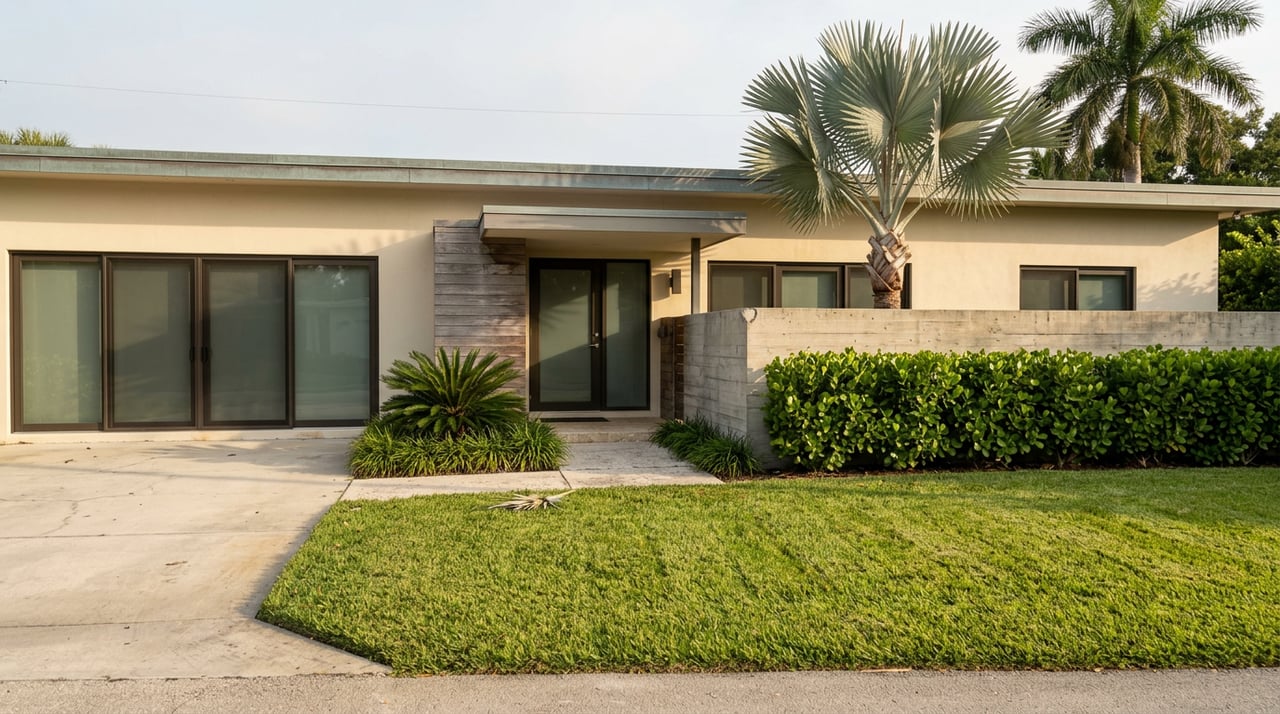
Walk a block off Dixie Highway into Pompano Beach Highlands on a Saturday morning and the street sounds the way it has for decades, on blocks of established, mid-century homes: a lawn mower two doors down, a screen door, maybe a dog tag jingling on the Crystal Lake path. Then, a few blocks over, a sound that has never belonged to this neighborhood before: the roll and clatter of skate wheels on concrete, coming from a plaza that did not exist a year ago.
That plaza is Community Park at 1701 NE 8th Street, and on July 22, 2026, the city cut the ribbon on Pompano Beach's first purpose-built public skatepark. It is not a small addition to a swing set. It is 20,000 square feet of two competition-style bowls, a street-style plaza with stair sets and rails, and a custom fish sculpture skaters launch off, shaped after the pompano, the same fish the city is named for. Highlands, a neighborhood residents have long described as slow-paced, now sits a short walk from a piece of recreation infrastructure that draws riders from across the county.
What Actually Opened at 1701 NE 8th Street
The park was built by New Line Skateparks, a firm that specializes in skatepark design and construction, at a cost the city put at $1.8 million. It is free and open daily from 8 a.m. to 10 p.m., unsupervised, which means closed-toe shoes and a strapped helmet are the price of admission rather than a ticket.
The grand opening itself was not a quiet ceremony. Professional skaters including Brandon "Bam" Margera, Jamie Foy, and Zion Wright showed up for demonstrations alongside a lineup of other pros, and the day included free beginner lessons, food trucks, and giveaways that ran into the evening. For a neighborhood whose closest brush with a big public event has typically been a holiday concert at the city's amphitheater a few miles south, that is a different kind of Saturday.
Why Broward Had to Wait This Long For One
In its coverage of the ribbon cutting, The Atlantic Current reported that Recreation Administrator Mark Beaudreau described nearly fifteen years of funding fights, advisory board debates, GO Bond questions, and location changes before construction ever broke ground, saying the project seemed to be always in jeopardy.
That delay matters for understanding why this particular park is drawing riders well beyond Pompano Beach's city limits. The Atlantic Current described South Florida as a bit of a "dry zone" for the skate community, meaning skaters, BMX riders, and scooter kids across Broward County had few, if any, comparable public facilities close to home. A park this size, with competition-grade bowls, is not a neighborhood amenity in the way a new playground would be. It is regional infrastructure that happens to have landed inside a quiet postwar subdivision, which means Highlands is now a destination for a group of visitors it has never really had before.
The Quiet Half-Mile This Landed Next To
What makes this pairing unusual is what already existed a few streets away. Crystal Lake Natural Area, a 24-acre sand pine scrub preserve at 3299 NE 3rd Avenue, offers a 0.4-mile paved, wheelchair-accessible loop that has long been the neighborhood's low-key answer to a morning walk: joggers, dog walkers, and birders moving quietly through one of South Florida's more delicate scrub ecosystems, with interpretive signs along the way.
Head the other direction and North Dixie Highway carries the neighborhood's other daily rhythm, a relaxed run of Latin American, Caribbean, and classic diner spots that residents have relied on for casual meals for years. A small plaza on Sample Road near NE 10th Avenue rounds things out with a grocery store and pharmacy, the kind of everyday errands that do not require leaving the neighborhood at all.
None of that changed when the skatepark opened. What changed is that Highlands now holds both ends of a spectrum in the same square mile: a nearly silent nature loop on one side, and a 20,000-square-foot concrete plaza built for tricks and speed on the other.
What a Saturday in Highlands Looks Like Now
Map an actual weekend onto this and the shift becomes concrete rather than conceptual.
- Morning: a loop around Crystal Lake before the heat sets in, same as it's always been
- Midday: lunch along North Dixie Highway, picking from the corridor's diner and Caribbean spots
- Afternoon: Community Park, where the crowd now spans a seven-year-old on a scooter and a teenager working on an ollie, with families watching from the sidelines
- Evening: the park closes at 10 p.m., and the streets go back to being the streets they've always been
That afternoon block is the piece that didn't exist twelve months ago. It's also the piece that used to require a drive somewhere else entirely.
The Neighborhood's Range Just Got Wider
None of this rewrites what Highlands is. It's still a neighborhood built out mostly between 1940 and 1969, still walkable, still the kind of place where the Pompano Beach Highlands Civic Improvement Association meets on the first Tuesday of every month at the Highlands Recreation Center to talk through local priorities. What changed is the range of what a resident can do without getting in a car. A quiet lakeside walk and a competition-grade skatepark now sit inside the same short radius, which is not a combination this neighborhood has offered before.
For the skaters and BMX riders who used to have to leave Broward's dry zone behind and drive somewhere else, that reason to leave just disappeared. For everyone else in Highlands, the neighborhood picked up a second identity without losing its first one.
If you're watching how a change like this ripples into property values, foot traffic, or what buyers ask about when they call, that's the kind of read Hasnaa Boutros tracks closely across Broward County. Reach out anytime for a free home valuation or a straight conversation about what's actually happening in your corner of Pompano Beach.